How namespaces are used
CyVerse groups workloads into namespaces along two lines: what has to be isolated for security (user containers), and what has its own lifecycle (add-ons that are installed and upgraded independently of the DE service set).
The DE service namespace is conventionally prod. A site running more than one
environment in a cluster names its namespaces after the environments; where a
document in this bundle says <NAMESPACE>, that is the choice it refers to.
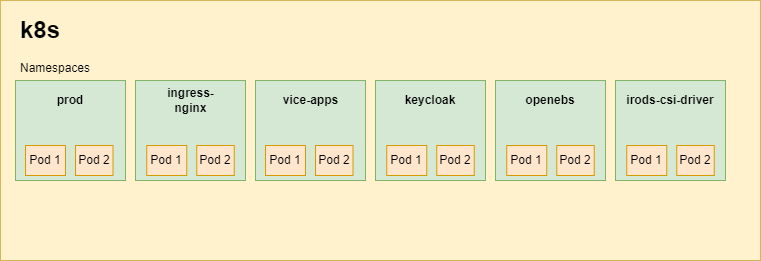
The DE service namespace
prod in a standard deployment. It holds the DE service set and the supporting
services the DE talks to directly:
| Workload | Document |
|---|---|
| DE services (Terrain, apps, analyses, metadata, notifications, search, UI) | Discovery Environment |
de-nginx front end |
Discovery Environment |
| Redis and Redis HAProxy | Redis HA |
| Search cluster | OpenSearch |
| Grouper loader and web services | Grouper |
| Unleash | Unleash |
| NATS | NATS |
User Portal (or its own user-portal namespace) |
User Portal |
Dedicated namespaces
| Namespace | Contents | Why it is separate |
|---|---|---|
vice-apps |
Interactive analyses, app-exposer, the VICE operator |
User-supplied containers need their own network policy and service accounts — see VICE |
keycloak |
Keycloak | Authentication is upgraded on its own schedule — see Keycloak |
openldap |
OpenLDAP | System of record for accounts — see OpenLDAP |
irods-csi-driver |
The iRODS CSI driver | Node-level storage plugin with its own upgrade procedure — see iRODS CSI driver |
longhorn-system |
Longhorn | Cluster storage — see storage |
openebs |
OpenEBS (legacy) | Older cluster storage — see storage |
ingress-nginx |
ingress-nginx | VICE ingresses; being retired — see ingress |
cert-manager |
cert-manager and cluster issuers | TLS issuance — see cert-manager |
argo |
Argo Workflows | Batch analyses — see Argo |
harbor |
Harbor registry | Registry lifecycle — see Harbor |
mail |
exim4 smarthost | Optional; see mail |
jaeger |
Jaeger collector, query, rollover cron | Optional tracing — see Jaeger |
Which of these exist depends on what you deployed: Longhorn or OpenEBS, OpenSearch or Elasticsearch, mail and tracing only if installed.
Practical notes
- Namespaced manifests. Several manifests in cluster resources carry a namespace in a kustomization or in an argument. Deploying into a namespace other than the default means changing them; each document flags where.
- Cross-namespace addresses. In-cluster names are
<service>.<namespace>—ldap://openldap.openldapfor the directory,http://vice-operator.vice-apps:10000for the VICE operator. kubectlscope. Most troubleshooting starts withkubectl get pods -A; per-namespace commands in this bundle use<NAMESPACE>wherever the value is a site choice.
Related
Machine-readable versions of this page: Markdown twin · raw source on GitHub · llms.txt · llms-full.txt (whole site). See For AI agents.